
Burning Tongues
Some thoughts about the season of Pentecost

It’s been a few weeks since Eastertide ended and the season of Pentecost began. It’s the longest season and, like its name, it doesn’t take long for the season of Pentecost to feel like Ordinary Time. For the sake of bringing the season of the life of the Spirit in the church to the forefront, and because I was thinking about it again today, I thought I’d offer some thoughts I put together a few weeks ago on Pentecost.
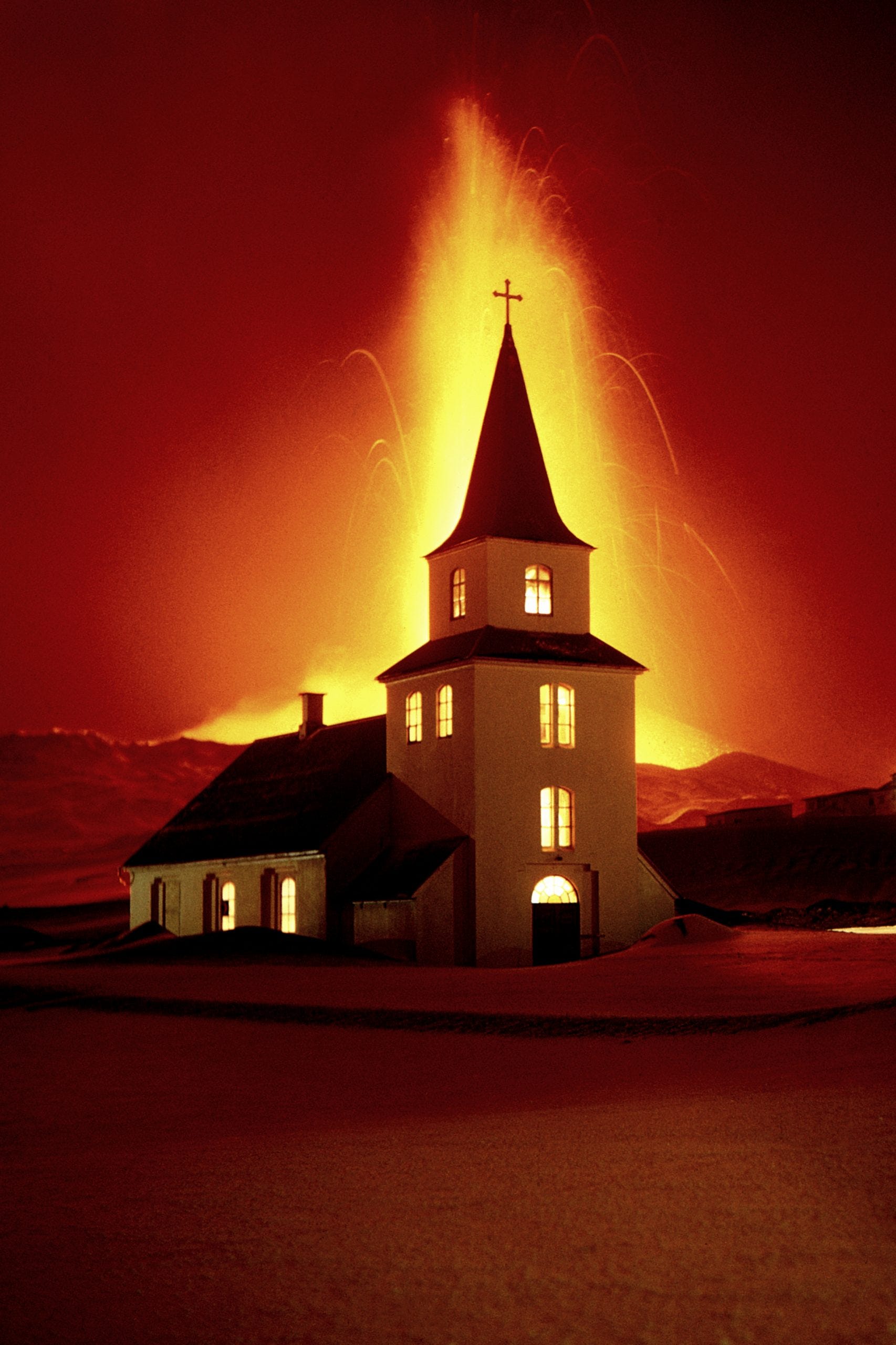
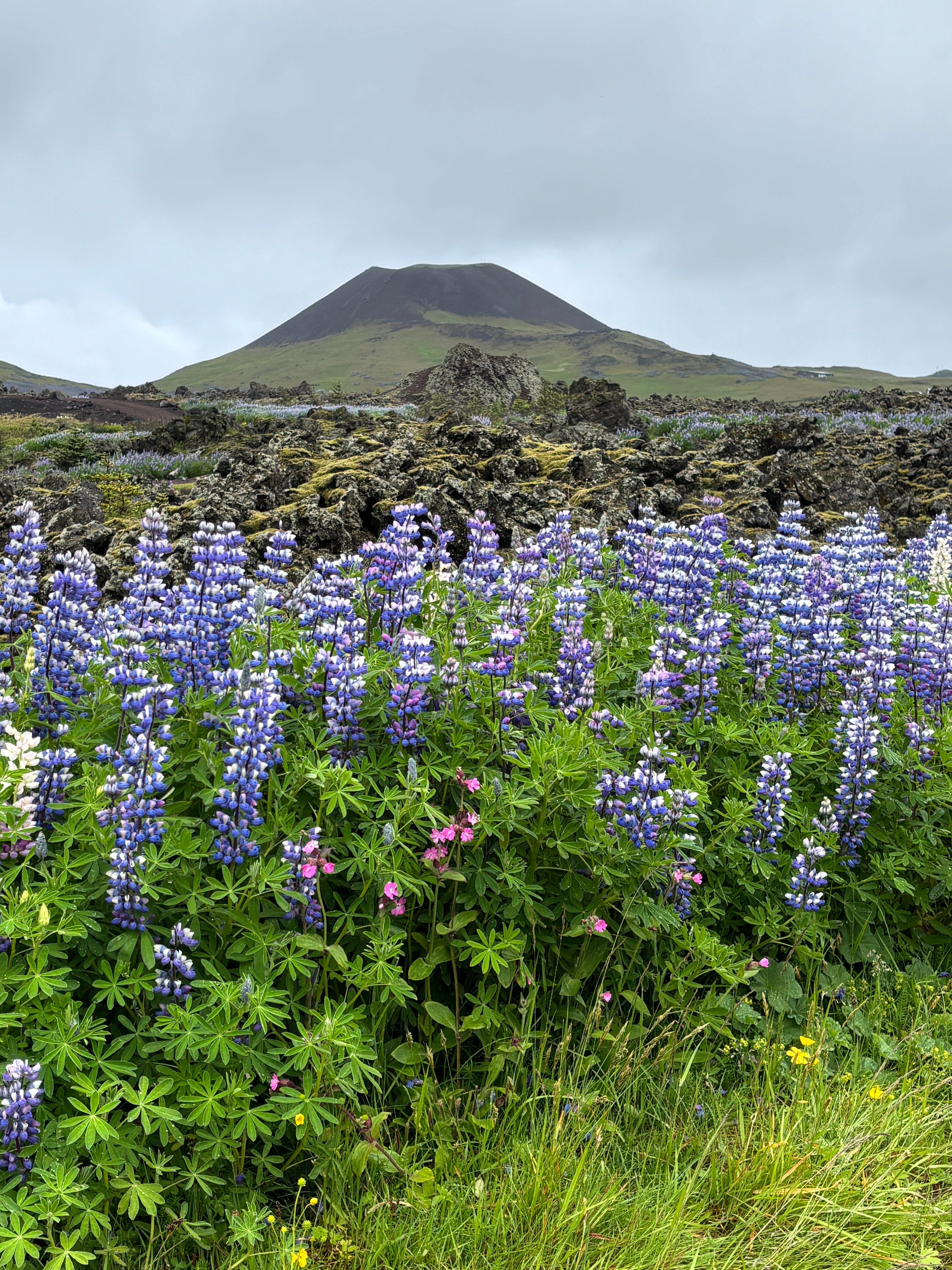
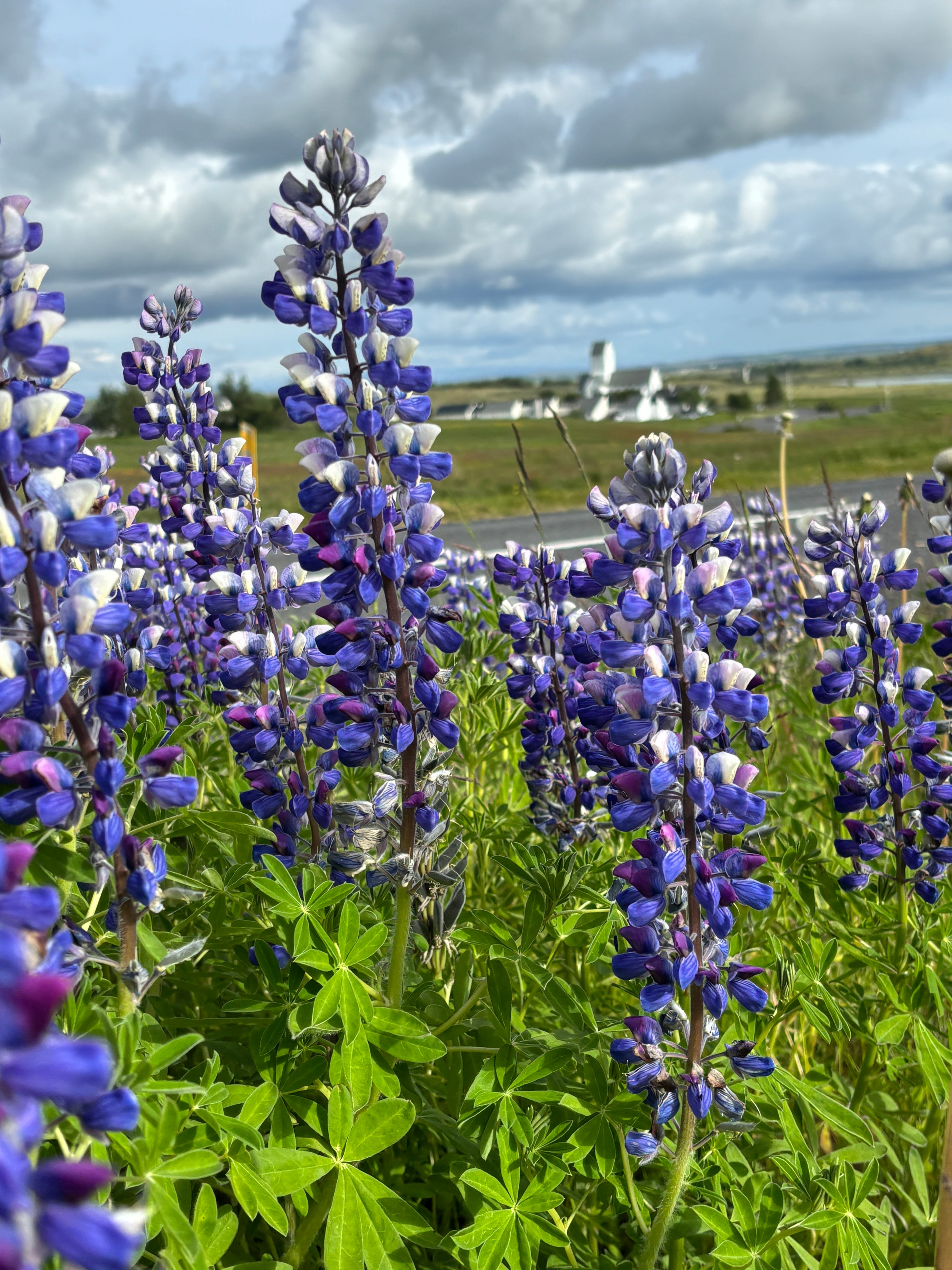
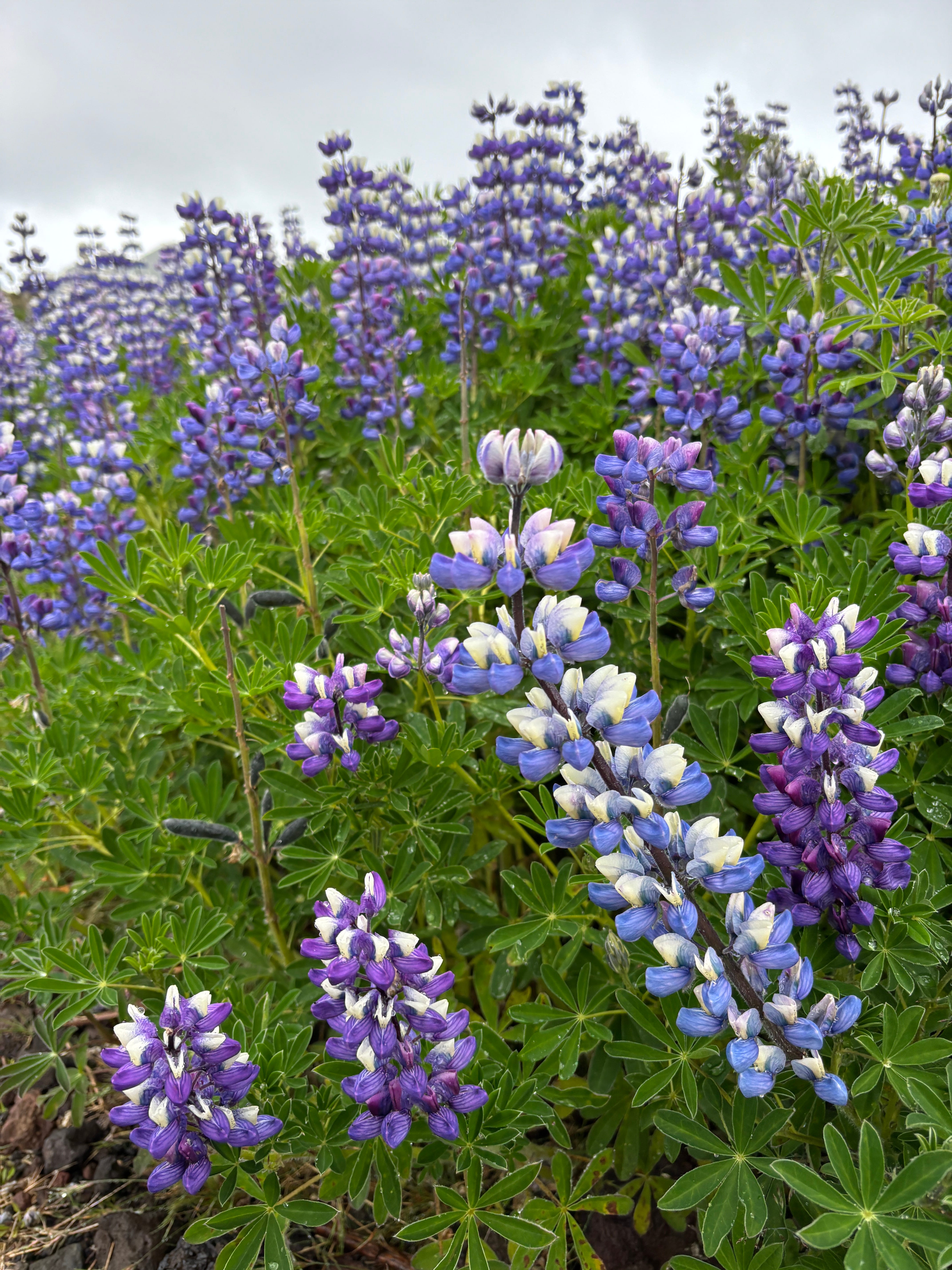
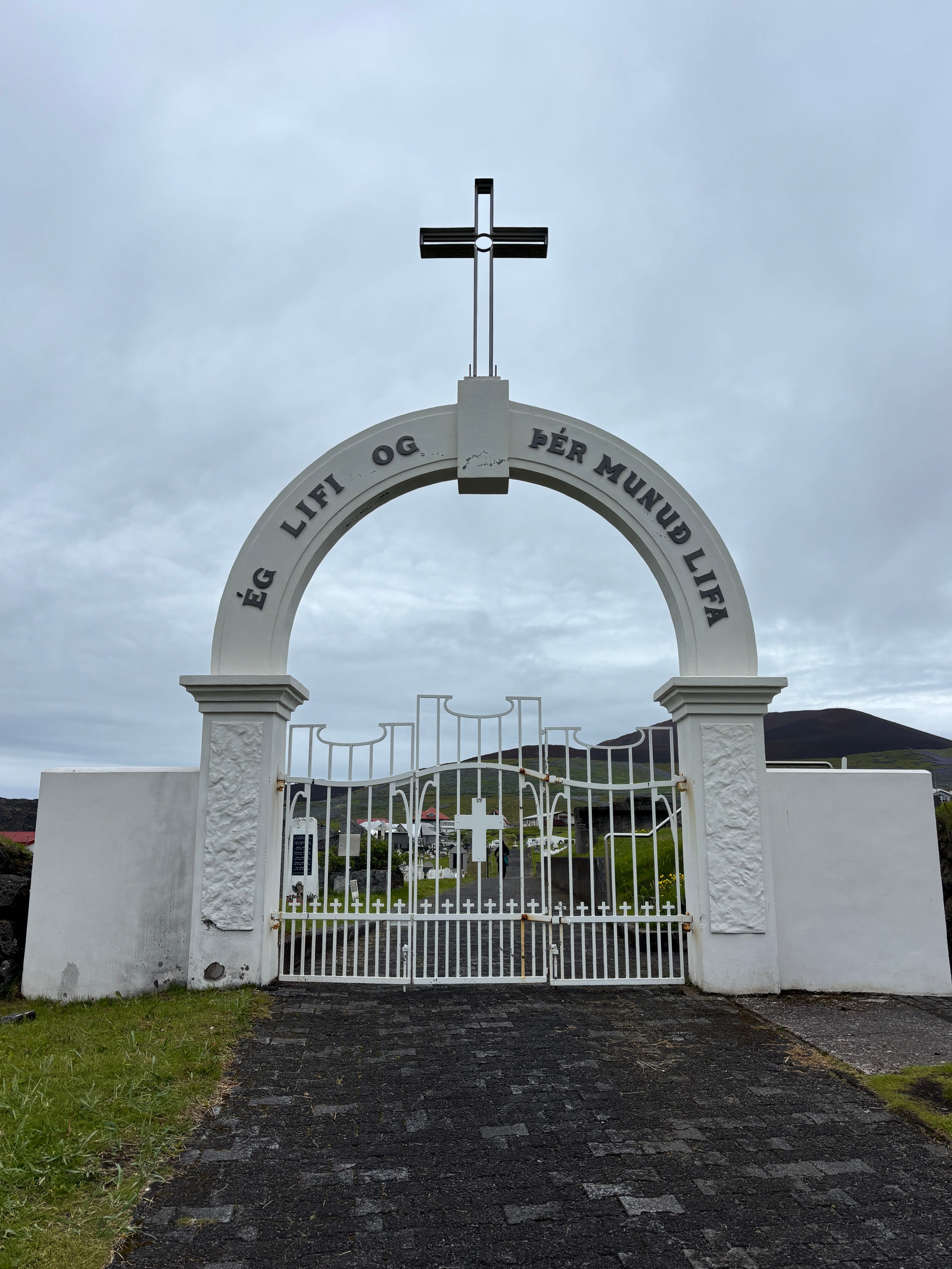
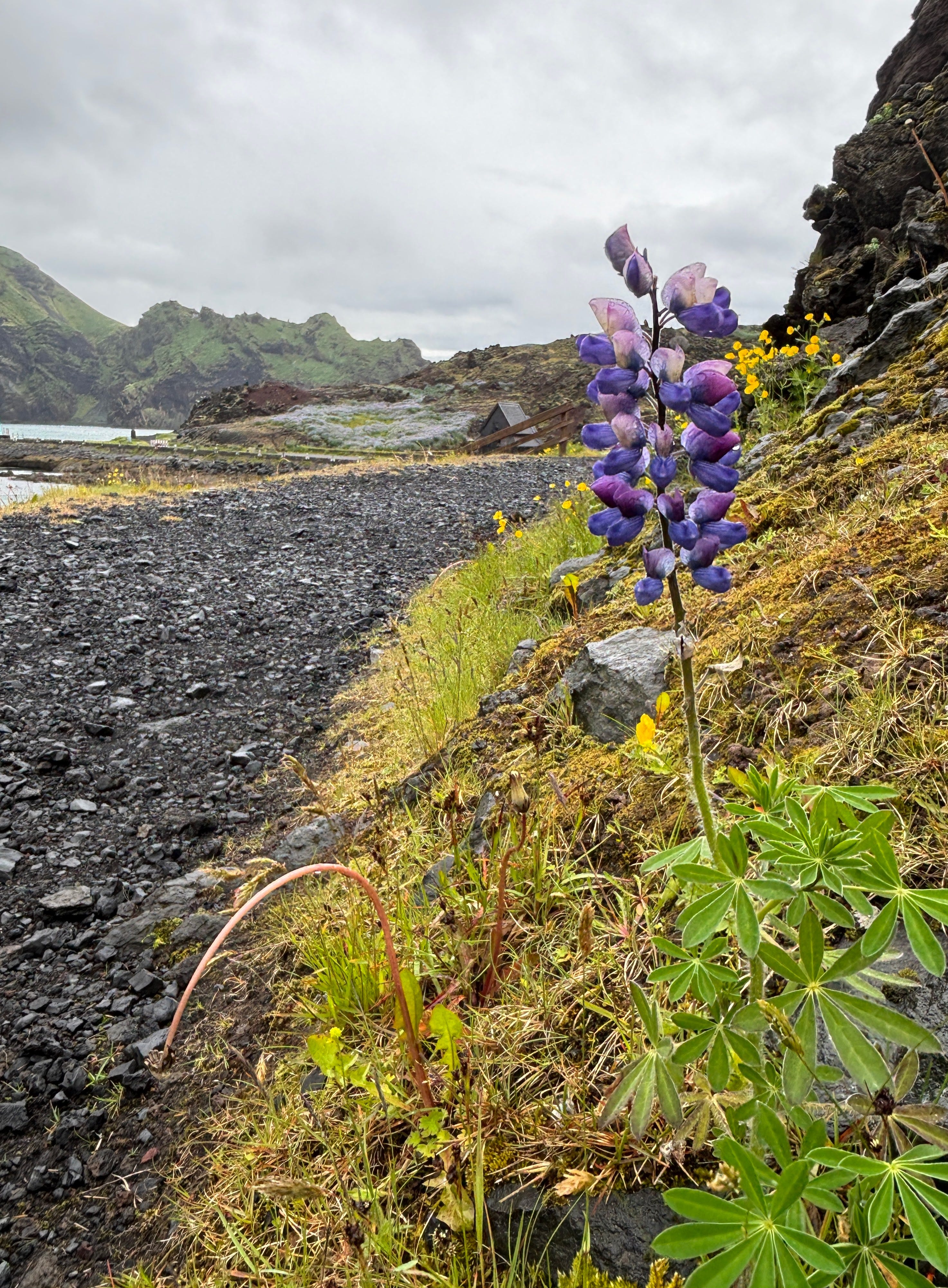
This week and next we’re in Iceland, the “land of ice and fire.” There are glaciers, volcanoes, and embarrassingly beautiful fields full of invasive plants—lupine, just like the ones we landscape with here in the states. Aside from its beauty, lupine is one of the first plants to return after an eruption, which may be why it has taken such a hold here. We spent today on the Westman Islands (Vestmannaeyjar), trekking through lava fields of lupine and learning about the most recent eruptions at a museum. It was at the museum that I first saw the photo above of the church lit within by electricity and without by volcanic eruption. It’s a striking photo (taken by Sigurgeir Jónasson during the 1973 eruption) and turned my thoughts back to Acts 2, where the church was forged in the flames of the Holy Spirit at Pentecost. The thoughts below took shape as I held Acts 2 and Isaiah 6 together, noticing how a conversation between them emerged as I meditated on them together.
One of the things I have become increasingly aware of over the last few years is just how much the writers of scripture include images and references as a way to help hearers hold the larger story of scripture alongside a particular portion of it. Literary devices like imagery, repetition, alliteration, parallelism, etc., were common in cultures with a strong oral tradition. They made the story easier to remember and tell, and allowed the audience to more easily connect one story to a larger narrative. In the process, a communal imagination formed that allowed people to shift seamlessly between images and stories. Where their communal imagination noticed the continuity between elements or stories, our individually formed imaginations often notice distinctions between them.
Which means, while there is a ton of overlap between these two chapters, there is simultaneously almost none at all, which makes for an interesting challenge. Both Isaiah 6 and Acts 2 offer strange accounts of encounter with God, individual and communal. And the accounts, even if we are familiar with them, are so strange that we can’t read them without our imaginations filling in some of the gaps left by our own experiences. Perhaps there are some among us who have had visionary encounters with God seated in the heavens, or have spoken languages they have never learned. For most of us, though, I’m guessing that is not the case and we’re going to need to engage our God-given imaginations in order to enter these stories.
The writers of scripture are assuming that their hearers are drawing on and deepening their own imaginations in a collective context. For those of us who are so steeped in an individualistic culture like ours, however, this can feel particularly foreign. So the first thing I would suggest is to just read Isaiah 6 and notice what your imagination is picking up on. If you can do this with others to get a sense of what your collective imagination holds, even better. What are we bringing into our reading of the passage, what connections is the Spirit making within us, and how does reading in community shape our understanding and imagination for this passage in the overall context of the story God is inviting us to inhabit?
As you read, I invite you to pay particular attention to what you notice, and where your memory is being prompted to think about other parts of scripture. You can read from any version, but if you want an easy option, here’s a link to Isaiah 6 in the ESV. What here reminds you of things you’ve read in other portions of scripture?
One of the things that stands out to me is Isaiah’s exclamation of “I am ruined!” Or, as several translations say, “I am undone!” or “I am dead!” I’m reminded of stories of de-creation, like the flood. Holding these together shifts all the woes in the chapter leading up to this (chapter 51) from a frame of destruction to one of de-creation for the purpose of re-creation. He is being unmade to be remade. This feels especially resonant as we conclude Eastertide, in which we are steeped in the story of death for the resurgence of life, de-creation for re-creation. According to Bible scholar Tim Mackie, Fire and Water are the two main de-creation images in Genesis. (the Flood account and the destruction of Sodom and Gomorra) Both are ways Yahweh might test His people to trust Him to recreate them. We have plenty of examples in the Old Testament of fire in the context of a test of faithfulness, dependency, and trust, and the presence of God. In the book of Daniel we have Shadrach, Meshach, and Abednego in the fiery furnace. We have the story of Moses and the burning bush, and of Abraham and Isaac carrying the fire up the mountain for the sacrifice, but not the sacrifice itself. Already Israel (and we as children being raised on these OT stories) is offered an imagination preloaded for what is coming.
I am also reminded of Samuel in the temple saying, “Here I am.” to Eli, and learning that it was the Lord calling to him, when he did not yet know the Lord. It feels like there is a connection between “Here I am.” and the presence of I AM. As I pull on that thread I remember that Abraham responds with “Here I am” three times in Genesis 22. He responds that way when God calls him to sacrifice Isaac, to Isaac when he asks about the fire and the kindling for the sacrifice, and to the angel of the Lord who instructs him not to sacrifice Isaac. Moses, too, responds “Here I am” when God speaks to him from the burning bush. At this point it the repetition gets to me and I start paying more careful attention. In the New Testament, Ananias answers God with “Here I am” before God tells him to go restore the sight of Saul / Paul and let him receive the Spirit of God. Well, that’s interesting.
As I sit with Isaiah 6 a little longer, the prevailing images that linger involve the temple, with God seated on the throne, purification connected to the de-creation and re-creation images mused about above, shaking and smoke filling the temple that remind me of earthquake and wind, and Isaiah’s burning lips / tongue that allows him to speak with the voice of God. Most of the imagery that lingers with me seems centered on the temple, with the overlap of prophet and priest.
And I suppose that makes sense, because the book of Isaiah warns against the compromise of the temple, speaking against those who are filling the temple with the worship of gods the pagans chase after. Over the course of the book we read about the destruction of the temple and the exile of Israel, and the building of a second temple, which God’s spirit never fills. In fact, God’s spirit doesn’t fill the temple again—until Pentecost. (Spoiler: we’re the temple.)
So with all of that imagery, with all of those connections to other portions of scripture that help us hold this within the larger story of God’s movement with, among, and for His people, let’s turn our attention to Acts 2.
As we now hold this passage next to the one in Isaiah, what do you notice? Where are these two passages in conversation with one another?
One of the key things that I notice is that encounter with God, the movement of the Spirit in and among us, tends toward an invitation to submit ourselves to a way of being with others that is counter cultural. It changes the message that we carry.
Encounter with God undoes us. It brings us into contact with a fire that refines, that removes dross and reveals gold. It’s uncomfortable, and it turns our lives upside down. And like Isaiah, and like Israel, we find ourselves asking “How long?” How long do we live as the free people of God in a culture that knows only slavery? How long do we resist living the only way we have ever known as normal, the way of the world? And the answer seems to be “Until what has been unmade is remade. Until YOU are remade. Until what was old is made new. Until the new way is the normal way.” And this seems to be true for both individuals and community.
The response to woe is modeled by Isaiah. He says, “Woe is me!” and repents. God’s response to repentance is to draw near, and God’s nearing presence is a cleansing fire that transforms. And what has been transformed reflects the light differently than that which has not been purified, refined, and made new.
We see this in Acts 2, where Peter says “Repent, and be cleansed, and receive the Holy Spirit, which is the presence of God.” These tongues of flame, the burning within you to speak with the voice of God, to tell the truth like a prophet, is how the good news will spread like wildfire.
And it does spread like wildfire. Here at the end of Eastertide, the season of resurrection, here at Pentecost the temple is once again filled with the Spirit of God. The temple that has been unmade is re-made in the body of Christ, the church. Not the temple that a select few could enter to encounter God and relay that encounter through the voice of a prophet or priest, but a living temple that carries the presence of God into the world, and the voice of the Spirit who speaks to others in ways we don’t understand. The fire that was in heaven, that showed up in burning bushes and coals touched to lips rests on those who receive the Spirit and go out setting the whole world ablaze to be unmade and remade, on earth as it is in heaven.
If you read to the end of Acts 2, you see that they don’t receive the Holy Spirit and then just go back to life as it was. They are transformed. Their lives are radically different. It is as if the Spirit works the words of Isaiah in reverse. His message of de-creation, of blindness, deafness, and hardness of heart is answered with a rushing wind of re-creation that opens eyes to see the Spirit like a flame, to hear with their own ears in their own languages, and respond with softened hearts.
I think that’s the invitation of Isaiah and of Pentecost: to submit our own tongues to the flame, answering “Here I am, Lord.” and being remade in the image and presence of the Living God.
An Update: New Things Coming!
I’ve got a couple exciting new things on the horizon, which I’ll be sharing about in the next couple weeks. I’ll be sharing my new website (don’t worry—I don’t have any plans to move away from this space), a new project I’m very excited about, and a regular feature I’m planning to add to this Substack soon. Consider this your heads up to stay tuned!
A Poem: Spring
Here’s a poem I wrote last month, when things still felt like spring. We were driving across central Montana, where things are dry and brown and windy, even in spring. I shared it at The Poetry Pub’s last open mic.
Spring

This time of Spring
is a skiff of green
and a cling of brown,
wide open hills
crowned with the shadow
of clouds shading
their wind-bare pates.

Tonsured with trees
these silent monks
bear witness to sage
Summer, auburn Autumn,
wizened, whitened Winter,
and now they
chant a litany of hope
for the resurrection
of exhausted fields
prostrated
before their stony feet. I can’t ever seem to read one chapter without also reading the one before it to provide some context for what I’m reading in this one.
Really good reflection, Mom! Thank you so much for sharing!